

Why in news?
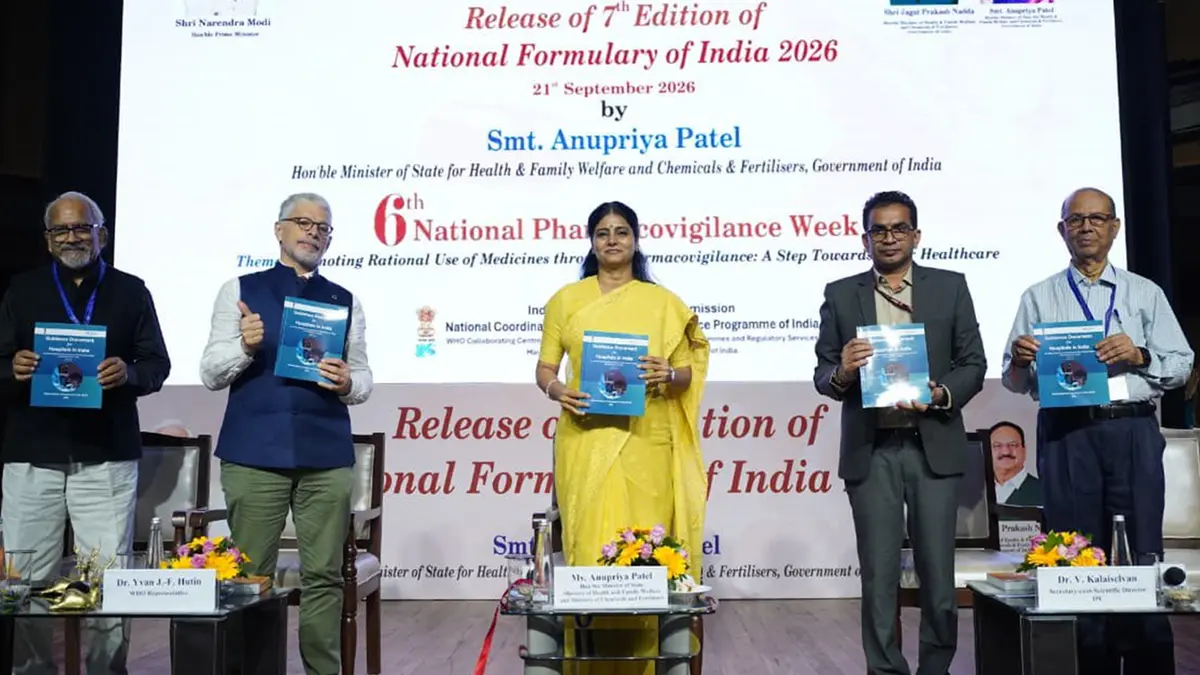
Union Minister of State Anupriya Patel launched the seventh National Formulary of India in New Delhi on 21 September 2026. The formulary is a professional guide to selecting, prescribing, dispensing and administering medicines safely and appropriately. Its updated edition is available in print and digitally, bringing revised medicine information together with links to health programmes and regulatory resources. At the same event, the government announced approval of a Biovigilance Programme of India covering safety concerns associated with organ and tissue transplantation. These measures address two connected needs: making better treatment decisions and learning from problems that emerge during care. The new programme's approval does not, by itself, establish that every reporting facility is already operational.
A formulary helps answer how a medicine should be used
The National Formulary of India, or NFI, is published by the Indian Pharmacopoeia Commission (IPC). It brings expert-reviewed medicine information into a form healthcare professionals can consult in practice. A medicine may be available in the market but still be unsuitable for a particular patient or situation. The guide helps connect the choice of a therapeutic agent with its appropriate use rather than treating availability as sufficient justification for prescribing it.
A formulary should not be confused with a promise that every listed medicine will be supplied free at every facility. Nor is it a substitute for the clinical assessment of an individual patient. Its value is as a common reference for professionals, including doctors, pharmacists and nurses. The information supports decisions rather than making them automatically. Clinicians must still consider the diagnosis, other medicines, patient characteristics and the circumstances in which treatment will be delivered.
Why rational use is more than taking fewer medicines
The World Health Organization describes rational medicine use in terms of matching treatment to clinical need, appropriate dose, duration and cost. The objective is not simply to minimise the number of medicines regardless of illness. It is to avoid unnecessary treatment while ensuring necessary treatment is effective and usable. An unsuitable drug, incorrect duration or unclear instructions can undermine care. This can happen even when the product itself meets quality standards.
For example, prescribing an antimicrobial where it is not indicated exposes a patient to cost and possible harm without the intended benefit. Rational use addresses such avoidable mismatches between the patient's needs and the treatment selected. Better reference material helps, but professional training and communication also matter. Patients need instructions they can follow, and healthcare teams need systems that make updated guidance accessible during actual consultations.
What the new edition contains
The government's launch release describes 34 chapters, 20 appendices and 653 medicine entries in the 2026 edition. These include 42 fixed-dose combinations and 30 immunologicals, medicines that work through the immune system. Both categories are included within the overall total. A fixed-dose combination brings more than one active ingredient together in a single formulation. Its convenience does not remove the need to consider whether the combination and its proportions suit the clinical situation.
The revision aligns medicine monographs with the National List of Essential Medicines and national health programmes. A monograph is a structured account of an individual medicine or formulation. The digital edition also links readers to programme information, immunisation schedules and resources on safe disposal. These connections help a reference guide serve practical decisions rather than remain a static list of drug names disconnected from the wider health system.
A long-running reference with a new edition
The first NFI appeared in 1960, followed by editions in 1966 and 1979. The health ministry assigned regular publication responsibility to IPC in 2008; subsequent editions appeared in 2011, 2016 and 2021. The 2026 release is therefore an update to an established reference, not the creation of India's first prescribing guide. Updating matters because available treatments, safety information and the balance of advantages between therapeutic options can change over time.
A new edition still needs to reach its intended users. Hospitals and teaching institutions must ensure that staff can find the relevant information and understand how to apply it. Digital access can reduce some distribution barriers, but availability alone does not prove routine use. Training, local medicine policies and review of prescribing practices remain important if the updated information is to influence patient care.
From suspected problems to useful safety evidence
Pharmacovigilance means detecting, assessing and preventing medicine-related harms and other safety problems. A suspected reaction can be reported before its cause is conclusively established. That is necessary because an isolated clinician may see only one part of a larger pattern. However, an event occurring after treatment is not automatically caused by it. Assessment must consider the timing, other illnesses, other medicines and whether similar observations recur.
The newly approved biovigilance initiative extends attention to adverse events associated with medicines and biological products used in organ and tissue transplantation. IPC is to lead work covering products administered to donors and recipients. This sits alongside existing medicine and medical-device monitoring. The distinction matters because a transplant-related problem may involve a product, a procedure or the patient's condition. Collecting reports is the beginning of an investigation, not a substitute for determining what happened.
Conclusion
The formulary and safety programmes address different stages of the same responsibility: choosing treatment well and learning from its real-world effects. The 2026 launch provides updated guidance and an approved expansion of surveillance. Its practical success depends on professional use, accessible reporting and careful assessment that turns suspected problems into reliable improvements in care.