

Why in news?
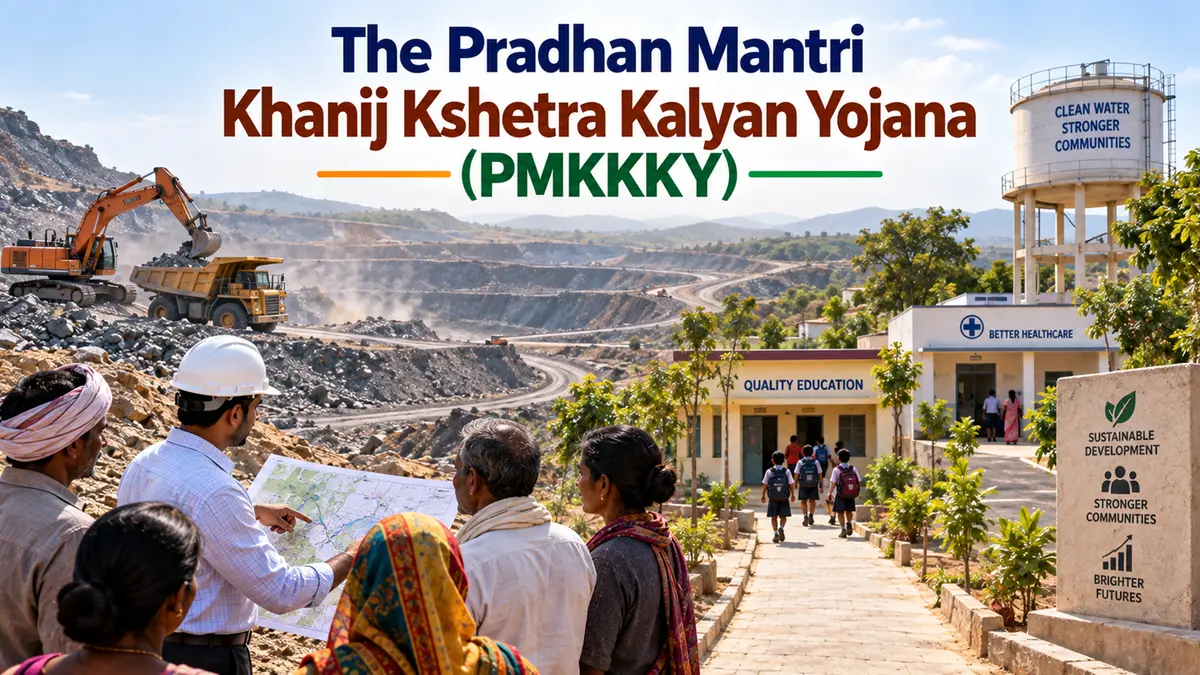
A government backgrounder issued on 17 September reviewed the Pradhan Mantri Khanij Kshetra Kalyan Yojana (PMKKKY), eleven years after its launch. The programme directs money collected from mining-lease holders towards people and places affected by mining. It operates through District Mineral Foundations (DMFs), rather than as a uniform cash payment to every resident of a mining district. The update reported 4,70,020 sanctioned projects and 2,92,156 completed projects as of July 2026. The scheme addresses a persistent imbalance: mineral extraction generates wider economic value, while nearby communities can bear pollution, displacement and livelihood costs. The latest account describes an existing programme’s progress, not a newly launched scheme.
The institution and the programme have different roles
The 2015 amendment to the Mines and Minerals (Development and Regulation) Act, 1957 introduced the statutory basis for DMFs. A foundation is a non-profit trust established for a mining-affected district. State governments prescribe its composition and functions. The foundation receives contributions and provides an institutional mechanism for directing them towards the people and areas affected by mining operations.
PMKKKY is the welfare framework that guides the use of those funds. Launched on 17 September 2015, it links mining contributions with local development priorities. The distinction is straightforward: the foundation is the institution, while the programme sets the purpose and spending framework. According to the September backgrounder, foundations had been established in 656 districts across 23 states.
The contributions are statutory payments, not voluntary donations by mining companies. They are linked to royalty, the payment due for mineral extraction. The arrangement seeks to reserve a share of mining-related revenue for affected communities. It does not mean that a company can substitute a charitable project for its required contribution or its separate legal obligations.
Who counts as affected?
The framework covers more than the land directly excavated for a mine. Mining can affect nearby water, air, transport routes and livelihoods. Someone may lose access to a traditional resource without owning the land being mined. Identifying beneficiaries therefore requires attention to displacement, occupation and customary use, rather than relying only on a list of formal landowners.
This is why a district-level plan needs a baseline: an account of existing conditions and the people experiencing particular problems. A drinking-water intervention, for example, needs information about supply reliability and quality. Simply locating a project somewhere inside the district does not establish that it reaches the communities bearing mining’s costs. The connection between the problem and the proposed work matters.
How the revised spending priorities work
The revised guidelines issued in January 2024 require at least 70% of programme funds for high-priority sectors. These include drinking water, health, education, sanitation, housing and livelihood-related needs. Up to 30% may support other priority areas, including physical infrastructure, irrigation, energy and watershed development. The framework therefore places social needs ahead of treating every available rupee as a general construction fund.
The rules are intended to supplement existing public programmes rather than replace them. A health facility illustrates the practical difference between a building and a service. Equipment, staff and supplies must accompany the structure if patients are to benefit. The revised guidelines explicitly recognise this need to make facilities effective, not merely to create infrastructure that can be counted.
A separate safeguard preserves the polluter-pays principle. Work that a polluter is legally responsible for undertaking cannot simply be shifted onto PMKKKY funds. Otherwise, money intended for affected communities would subsidise obligations that belong to the operator. Welfare spending and enforcement of environmental responsibilities must therefore proceed together, rather than one being offered as a substitute for the other.
Participation and public scrutiny
The revised framework includes special safeguards in Scheduled Areas. These include Gram Sabha involvement in approving plans and identifying beneficiaries. A Gram Sabha is the village-level assembly, making its role different from that of an outside contractor or departmental office. Participation is meaningful when affected people can influence priorities before funds are committed, not only hear about completed decisions.
Disclosure also needs to connect money with work on the ground. The guidelines require public information on contributions, projects, costs and progress, alongside reporting and audit arrangements. Such records allow people to ask whether a sanctioned project exists, whether it is functioning and whom it serves. Audit establishes financial accountability; service monitoring is also needed to understand the benefit achieved.
Reading the July figures
The official update associates sanctioned projects with ₹1,09,938 crore and completed projects with ₹49,973 crore. It separately lists 78,809 ongoing works with ₹30,512 crore committed. These are different stages of implementation. A sanction permits a project; a commitment reserves resources; completion records a later administrative stage. None of these labels alone measures improved health, cleaner water or sustained household income.
Conclusion
PMKKKY provides a mechanism for connecting mineral wealth with the welfare of affected communities. Its value depends on identifying real needs, choosing suitable projects and keeping services functioning afterwards. The anniversary figures show the scale of activity, while community participation and public scrutiny help test its relevance. The ultimate outcome must be better living conditions, not simply a larger list of sanctioned works.