

Why in news?
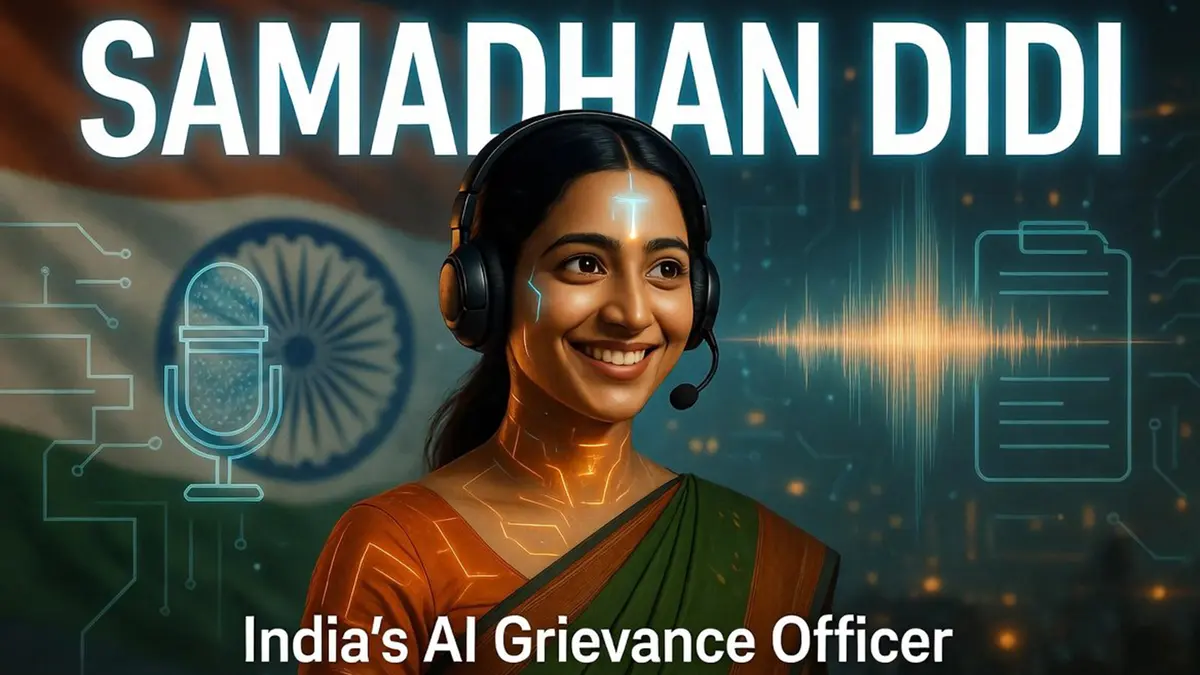
The Union government has launched Samadhan Didi, an artificial intelligence‑enabled voice assistant integrated with the Centralised Public Grievance Redress and Monitoring System (CPGRAMS). The chatbot allows citizens to lodge complaints simply by speaking in their own language, simplifying access to government services.
Background
CPGRAMS is an online platform created in 2007 to receive and monitor public grievances against central and state government departments. The number of grievances has grown from about two lakh in 2014 to over 25 lakh per year, with disposal rates exceeding 95 percent. Yet many citizens struggle with language barriers or are unsure which department to approach. The government’s language technology initiative Bhashini aims to develop speech‑to‑text and translation tools for Indian languages, paving the way for AI‑enabled services.
How Samadhan Didi works
- Voice‑first interface: Citizens can call or use a mobile app and speak their grievance in their preferred language. The AI system listens, understands the issue and seeks clarifications when needed.
- Automatic classification: Using natural‑language processing the chatbot identifies the correct ministry or department and the category of grievance. It then files the complaint in CPGRAMS without requiring the user to navigate menus or draft written applications.
- Multi‑language support: At launch Samadhan Didi supports all 22 languages of the Eighth Schedule of the Constitution; additional regional languages including Bhojpuri, Garo, Khasi, Mizo and Bodo are being added in phases. The system operates within a secure government environment to protect personal data.
- Expansion plans: Authorities plan to integrate the chatbot with state grievance portals and expand it across all 22 scheduled languages and more dialects. The aim is to make grievance redressal accessible to every citizen, regardless of literacy or digital skills.
Conclusion
Samadhan Didi marks a significant step towards inclusive governance. By harnessing voice recognition and artificial intelligence, the government empowers people who may be illiterate or unfamiliar with formal procedures to seek redress. As more languages and regions are added, the platform could become a model for citizen‑centric digital services.