

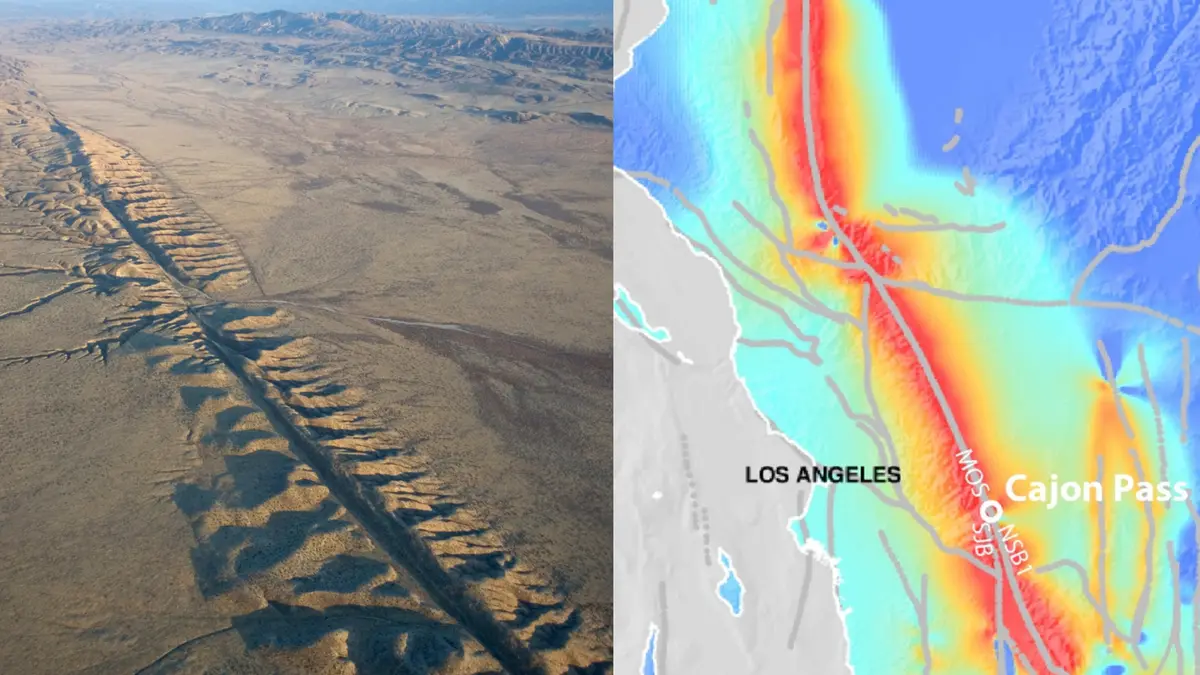
Why in news?
A recent study modelling more than 1,000 years of earthquake history found that the San Andreas and San Jacinto faults in southern California are currently under the greatest stress in a millennium. The research suggests that both faults could rupture together, increasing the risk of a major earthquake.
Background
The San Andreas fault is a 1,300‑km‑long transform boundary between the Pacific and North American tectonic plates. It formed about 30 million years ago and runs from the Gulf of California northward through the U.S. state of California before entering the Pacific Ocean near San Francisco. Movement along the fault is mostly horizontal: the Pacific Plate slides northward past the North American Plate. Major earthquakes occurred along this fault in 1857 and 1906, shaping California’s geological history.
Findings of the new study
- Physics‑based model: Researchers used a physics‑based simulation incorporating a thousand years of earthquake records to estimate current stress levels on the San Andreas and its branch, the San Jacinto fault.
- Stress alignment: The model shows that stress levels on both faults have reached or exceeded peaks seen before past large earthquakes. When stresses align, a rupture on one fault could jump to the other, producing a multi‑fault event.
- Earthquake gate: The Cajon Pass region, where the two faults meet, acts as an “earthquake gate.” Whether a rupture stops there or continues depends on the stress state of both faults. The current configuration favours a through‑going rupture.
Implications
Southern California hosts millions of people and critical infrastructure. A joint rupture of the San Andreas and San Jacinto faults could produce a very large earthquake, causing widespread damage. The study does not predict an imminent quake but highlights the importance of preparedness, seismic retrofitting and improved early‑warning systems.
Conclusion
The San Andreas fault remains one of the world’s most studied geological features. By showing that stress levels are at a thousand‑year high, the new research underscores the need for vigilance. Continued monitoring and public awareness are essential to reduce the impact of future earthquakes.