

Why in news?
The Directorate of Revenue Intelligence seized 86 live Tokay Geckos at Mariani in Assam on 22 September. The Finance Ministry reported that two people were apprehended during an operation based on information about an alleged illegal wildlife deal. The animals and the two individuals were handed to the local forest authorities for further action. The Tokay Gecko is a large, mainly nocturnal lizard found across parts of South and Southeast Asia. Demand for exotic pets and purported medicinal uses can draw it into wildlife trade. The seizure brings both the suspected transaction and the animals into official custody for further action. It does not establish a conviction or reveal every animal's original capture location.
Recognising the animal and its habitat
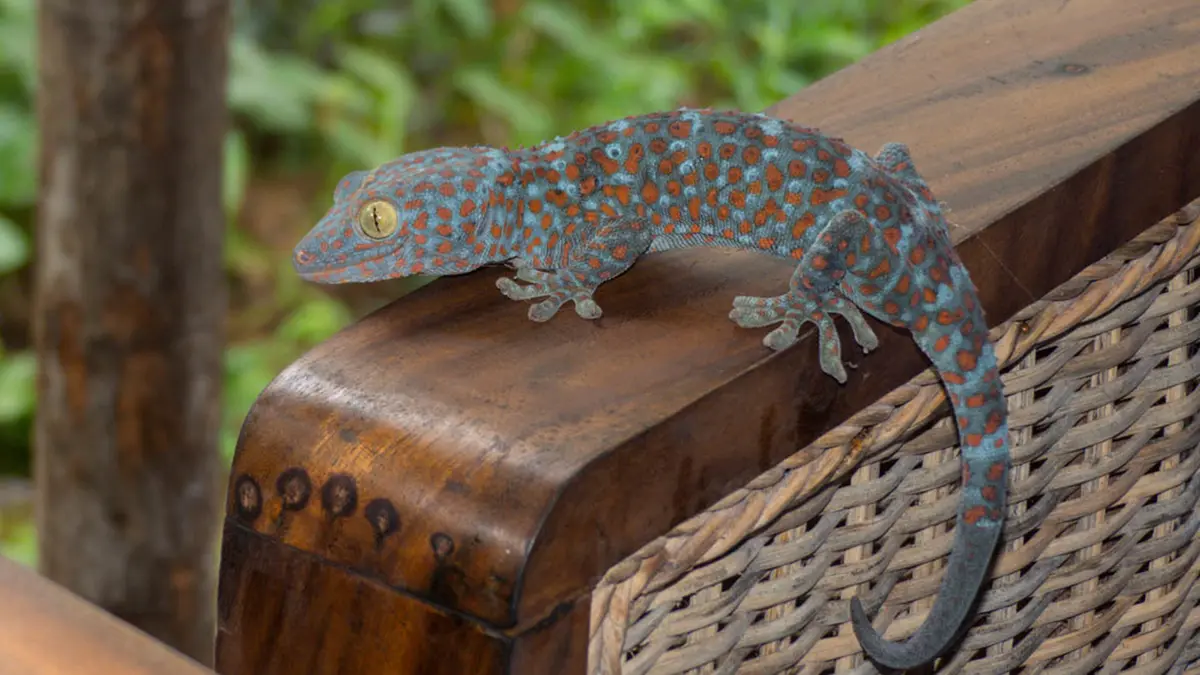
The species' scientific name is Gekko gecko, and it belongs to the gecko family, Gekkonidae. Its broad head, prominent eyes and spotted body distinguish it from many smaller house geckos. It commonly has a greyish background with reddish spots. The familiar name echoes its loud call. It is primarily active at night and uses trees, cliffs and, in some places, structures around human settlements.
Its range extends from northeastern India through parts of mainland Southeast Asia towards the Indo-Australian archipelago. Tropical forest and other suitable sheltered habitats support its activity. Fine structures on the toes help it cling to steep surfaces, while its mainly insect-based diet links it with local food webs. These features explain how it lives; they do not make capture harmless simply because an individual can also be found near a building.
What trade investigations have established
Research by TRAFFIC, the wildlife-trade monitoring organisation, has documented substantial demand for Tokay Geckos in parts of Asia. Its investigations have examined both traditional-medicine markets and claims surrounding unusual medicinal uses. The existence of a market demonstrates demand, not the effectiveness of a treatment. Repeating a trader's claimed health benefit as a biological fact would therefore misrepresent what the trade evidence establishes.
TRAFFIC has also questioned whether some declared commercial breeding operations could plausibly produce the numbers attributed to them. This raises the possibility of wild-caught animals being represented as captive-bred. That earlier research does not prove the origin of the 86 animals seized in Assam. It explains why investigators need to examine supply chains and documentation, rather than accepting a breeding claim without evidence.
Three different systems answer three different questions
India's Wildlife (Protection) Act, 1972 governs domestic protection and relevant wildlife offences. The official seizure release identifies the Tokay Gecko as a Schedule I species under that law. This is a legal status, not a measurement of its global population. The applicable restrictions cannot be dismissed because a species is relatively widespread elsewhere. National law can protect an animal even when its worldwide extinction risk falls below the threatened categories.
The Convention on International Trade in Endangered Species of Wild Fauna and Flora, or CITES, addresses international trade. Tokay Geckos are included in Appendix II. This appendix regulates trade through permits and conditions intended to avoid harmful exploitation. It is not the same as a universal prohibition on every international transaction. Nor does a CITES document override stricter domestic protection. The international and national requirements must be considered together.
The International Union for Conservation of Nature, or IUCN, assesses extinction risk through its Red List. The species' 2019 assessment classifies it as Least Concern, as recorded in the IUCN–TRAFFIC analysis and subsequent taxonomic reporting. That classification is distinct from both Schedule I and CITES Appendix II. The word “endangered” in a general enforcement announcement should not be silently converted into the specific IUCN category “Endangered”. These labels describe different systems.
Why a widespread species can still need protection
A broad geographical range does not mean that every local population is secure. Repeated capture can reduce animals in accessible places even when populations persist elsewhere. Global assessments and local enforcement therefore operate at different scales. A seizure identifies a particular suspected trade event; it does not provide a complete population survey. Conversely, the absence of an immediate global extinction threat does not make unregulated collection sustainable.
Conservation also includes the fate of animals after interception. A live seizure creates responsibilities for safe custody, identification and appropriate decisions about subsequent care. It should not be assumed that every recovered animal has already been released successfully. In this case, the published account records transfer to the Mariani Range Forest office. Later outcomes would require their own evidence rather than being inferred from the word “rescued”.
What would strengthen the response?
The next investigative questions concern where the animals came from, who organised their movement and what documentation accompanied them. Answering those questions could help distinguish local collection from a wider supply chain. Habitat monitoring and demand reduction address different parts of the problem. Enforcement can interrupt a transaction, while sustained conservation requires reducing the pressures that make repeated capture profitable.
Conclusion
The Assam operation documents a significant live-animal seizure and the start of further wildlife-law action. Its broader lesson is that trade legality, national protection and global extinction risk must not be confused. Clear reporting of each helps explain why a widespread species may still face serious local exploitation. The enduring conservation outcome will depend on both the investigation and the care of the animals recovered.