

Why in news?
Karnataka minister Ramalinga Reddy directed an investigation into reported industrial effluent discharge into the Bhima River in Yadgir district. The complaint concerned the Kadechur-Badiyal industrial area. The Hindu reported the directions on 28 September, including inspections, wastewater sampling and action against industries found violating pollution standards. Effluent is liquid waste released from an industrial process; its effects depend on what it contains and how it has been treated. The Bhima feeds the Krishna, so water-quality problems can affect a connected river system rather than one isolated site. The reported development was an order to investigate and enforce compliance. It did not establish that every allegation had already been proved or that the affected water had become safe.
Following the river through its basin
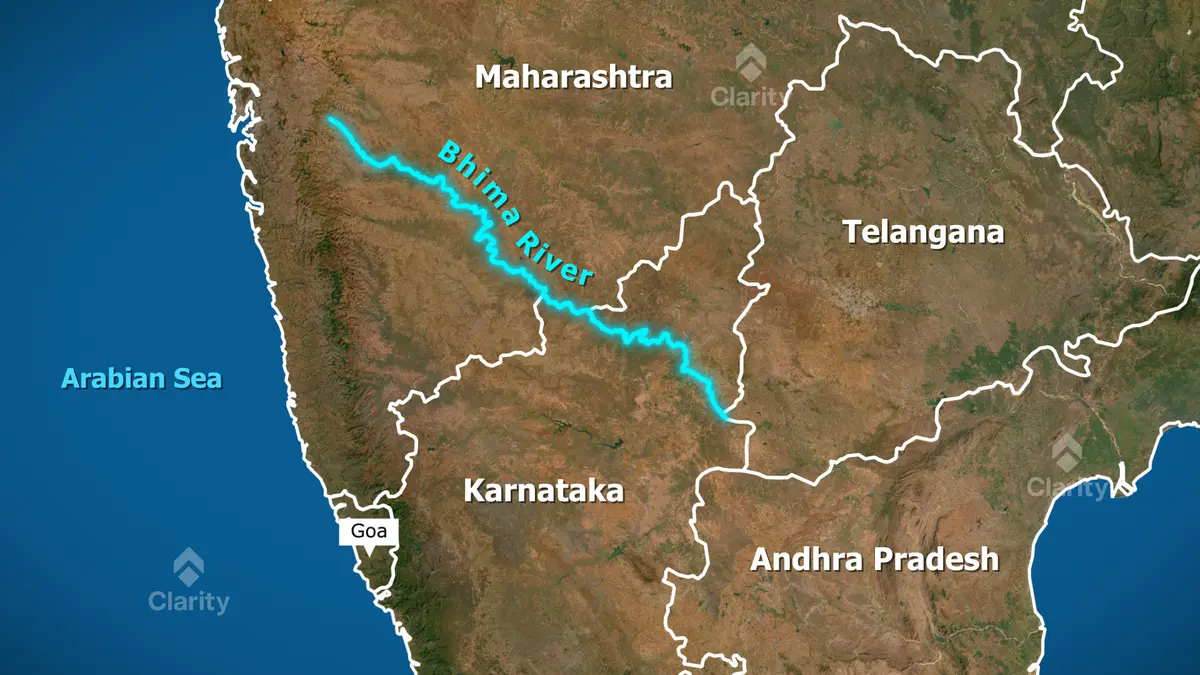
The Bhima rises near Bhimashankar in Maharashtra's Western Ghats and flows generally southeastwards to join the Krishna near Raichur. The Central Water Commission describes it as a left-bank tributary of the Krishna. River banks are identified while facing downstream. This convention avoids confusion when a map is rotated or a river bends through different directions.
The commission gives the Bhima a length of about 861 kilometres and a catchment of roughly 70,614 square kilometres. Its drainage system extends across Maharashtra, Karnataka and Telangana. A catchment is the land from which water drains into a river and its tributaries. It is broader than the river channel, so listing catchment states does not describe an identical channel course through each state.
Major tributaries include the Mula, Mutha, Nira, Ghod, Man and Sina. The Bhima is the Krishna's longest tributary by the commission's length comparison. It is not the largest sub-basin by drainage area: the Tungabhadra's catchment is larger in the same account. Defining the measure prevents two different geographical rankings from being treated as a contradiction.
Why a discharge affects more than its outlet
A river carries water and material downstream, connecting an upstream discharge with places beyond the industrial boundary. The extent of an effect depends on the substance, the quantity released and river conditions. An investigation therefore needs to examine both the suspected outlet and the receiving water. A complaint at one point is a reason to investigate, not a complete description of the whole basin's condition.
Water can also appear clearer without having become suitable for every use. Colour and smell may alert observers to a problem, but they cannot identify all contaminants or their concentrations. Laboratory testing helps establish what is present. Comparing results with the applicable standards then addresses a separate question: whether the discharge or receiving water meets the relevant requirements.
Oxygen demand explains one important pathway of harm
Fish and many other aquatic organisms depend on oxygen dissolved in water. Microorganisms use some of that oxygen while breaking down organic material. If decomposition consumes oxygen faster than it is replenished, aquatic life can be affected. The process explains why an organic waste load may cause harm even without a visibly dramatic chemical spill.
Biochemical oxygen demand measures the oxygen used during the breakdown of organic matter under specified test conditions. It is a useful indicator, but it is not a test for every toxic substance. An investigation of industrial wastewater must select measurements appropriate to the process and suspected pollutants. No particular contaminant concentration is established by the current news report.
Inspection, evidence and enforcement form a sequence
The Karnataka State Pollution Control Board was asked to inspect the industries, test samples and determine compliance. India's Water (Prevention and Control of Pollution) Act, 1974 provides the relevant regulatory framework. Its provisions separately address sampling, inspection, polluting discharges, consent and directions. These are related powers, but they are not one undifferentiated act of declaring a factory guilty.
The distinction matters in this case. An instruction to collect samples starts an evidence-gathering step. Results must be linked to the source and assessed against the applicable requirements. An order to act against violators is conditional on identifying violations. It should not be reported as a completed closure, conviction or remediation programme without evidence that those later steps occurred.
The report also described a requested inquiry into an alleged official lapse and a compliance report on action taken. These concern administrative accountability as well as industrial conduct. A compliance report would be useful if it records findings, directions and follow-up, rather than merely confirming that an inspection team visited. The substantive outcome is whether the source of harm is controlled.
Conclusion
The Bhima complaint links industrial regulation with the geography of a shared river basin. The immediate next evidence is the inspection and sampling record, followed by action on any established violations. An announced inquiry is not the same as restored water quality. Sustained improvement would require control of the discharge and monitoring that shows the receiving river meets the relevant needs and standards.