

Why in news?
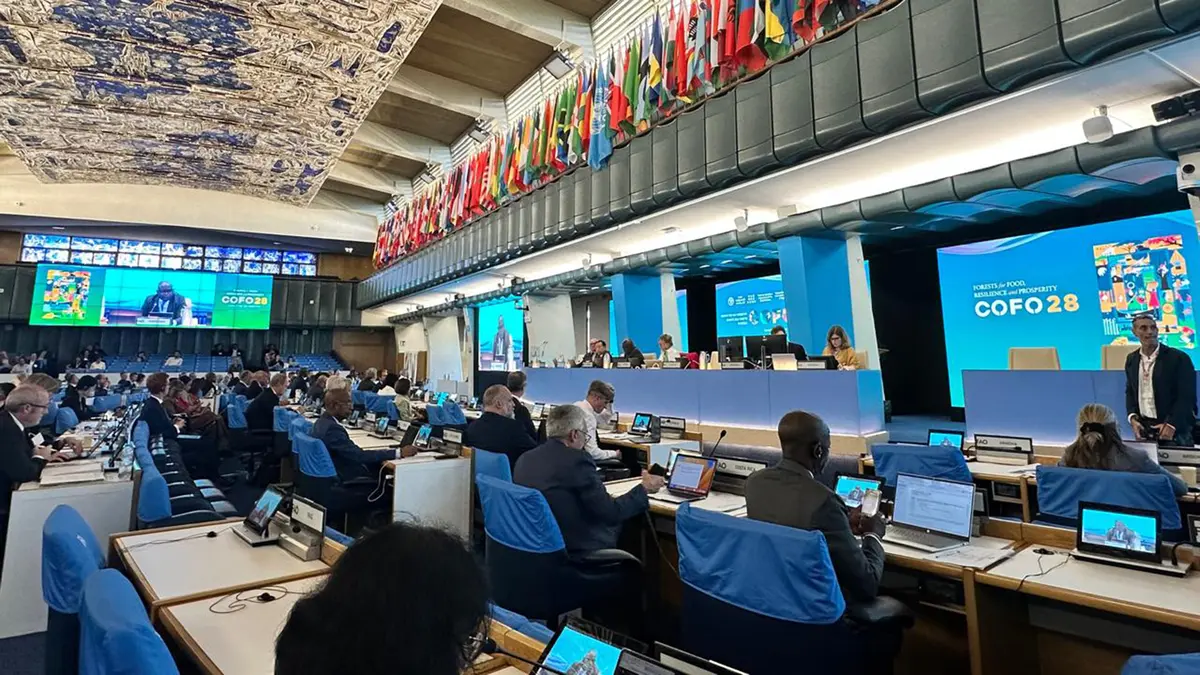
India presented its forest-restoration priorities at the 28th session of the Committee on Forestry in Rome on 28 September 2026. The committee belongs to the Food and Agriculture Organization of the United Nations, commonly called FAO. Its meeting, scheduled through 2 October, brings governments together to discuss forestry policy and cooperation. India emphasised restoring degraded landscapes, supporting communities and improving finance and technical assistance. Restoration concerns the recovery of ecological functions and benefits for people, not simply an increase in planted trees. The intervention matters because forests, farms, water and livelihoods interact across the same landscape. It was a national position presented during an ongoing meeting, not a completed international agreement.
What the committee does
The Committee on Forestry, or COFO, is FAO’s highest intergovernmental forestry forum. Its members meet every two years to examine emerging issues and guide the organisation’s forestry work. The committee connects technical knowledge with government priorities. It helps countries identify shared problems, discuss approaches and shape international assistance. It does not directly manage their forests or replace national law.
Its institutional relationships explain how discussions move beyond a conference hall. COFO reports to the FAO Council on programme and budget matters, and to the FAO Conference on policy and regulatory matters. Regional forestry commissions bring geographically specific concerns into the wider process. This arrangement allows local and regional experiences to inform global priorities without assuming that every forest faces identical conditions.
Restoration is more than planting
FAO describes forest and landscape restoration as recovering ecological functioning while improving human well-being in degraded landscapes. A landscape may include natural forest, agricultural fields, grazing land, settlements and watercourses. Improving it does not require converting every part into dense woodland. The appropriate mix depends on the original ecosystem, current land use and the needs of people who depend on it.
For example, protecting natural regeneration can be more appropriate than planting new saplings where native vegetation can recover. Elsewhere, erosion control or better management of farm trees may address the immediate problem. These are different interventions with a shared purpose: restoring useful ecological relationships. A successful programme must therefore ask what has been damaged before deciding which activity to fund.
This distinction changes how results are measured. Counting seedlings records an input, while checking survival records an early outcome. Neither measure alone describes the recovery of habitat, soils or water regulation. A plantation can contain many trees without reproducing the diversity of a natural forest. Restoration needs suitable indicators for its particular purpose, followed over enough time to reveal whether the improvement lasts.
Reading India’s figures carefully
India’s official statement reported combined forest and tree cover of 82.74 million hectares, representing 25.17 per cent of its geographical area. The combined measure includes tree cover outside the forest-cover category; it should not be described as natural forest alone. The statement also referred to the commitment to restore 26 million hectares of degraded land by 2030 and ongoing work towards it.
Area brought under a restoration programme is not the same as area whose ecological recovery has been independently demonstrated. Similarly, carbon stored in vegetation measures a different attribute from species diversity or community access. These indicators can complement one another, but they are not interchangeable. A fuller assessment needs to connect the reported activity with the condition of the land and the people using it.
Why communities and finance matter
FAO’s restoration guidance treats stakeholders as participants in planning, not merely recipients of seedlings. Land users may depend on fuelwood, grazing, crops or forest products. A project that ignores those uses can shift pressure elsewhere or fail after initial funding ends. Agreeing on responsibilities and acceptable land uses helps make ecological recovery compatible with continuing livelihoods.
The 2026 committee agenda also connects forests with food security, fire management and the bioeconomy. These links make financing a longer-term question. Protecting a restored area, controlling damaging fires and tracking recovery require continuing capacity. India’s call for cooperation belongs in that implementation debate: technical guidance and finance are useful when they support locally workable action and credible assessment.
Conclusion
The Rome discussions place forest restoration within a wider landscape of land use, livelihoods and environmental change. India’s statement sets out priorities and reported progress, while the meeting was still in session on 30 September. The substantive test is whether interventions recover the functions they are intended to restore. That requires suitable local choices, sustained support and evidence beyond the number of trees planted.