

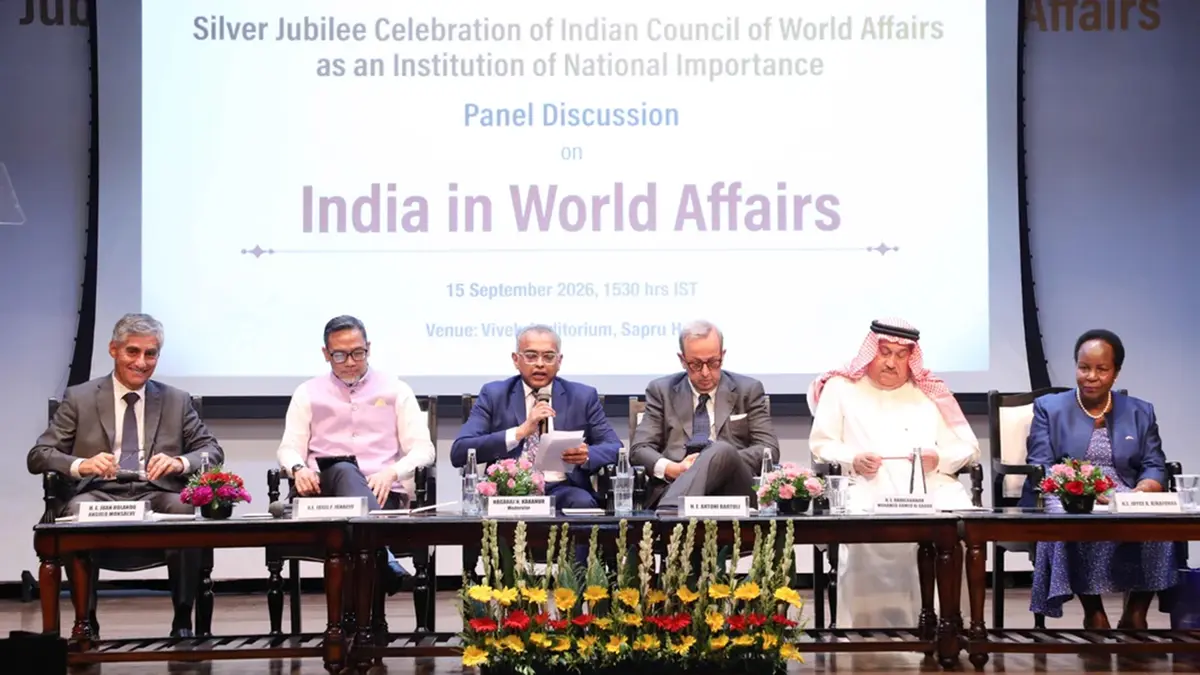
Why in news?
Vice-President C. P. Radhakrishnan addressed the Indian Council of World Affairs at Sapru House, New Delhi, on 15 September. The occasion marked 25 years of its recognition as an institution of national importance, not 25 years since its founding. He called for stronger research on India’s regional relationships, emerging technologies and global supply chains, alongside deeper links with universities. The Council studies international relations and provides a setting for scholarly and diplomatic exchange. The anniversary matters because foreign-policy choices increasingly connect security with technology, trade and domestic capabilities. The speech set out research priorities; it did not announce a new treaty, law or binding foreign-policy decision.
An institution older than independent India
The Indian Council of World Affairs, commonly called ICWA, was established in 1943. It began as a non-official, non-political and non-profit organisation studying world affairs. Its founders sought a space in which Indians could examine international questions from their own perspective. This origin predates both independence and the Council’s later statutory status.
Sir Tej Bahadur Sapru was its founder-president. The Council’s headquarters, Sapru House, was inaugurated by Jawaharlal Nehru in May 1955. It became a meeting place for scholars, public figures and visiting international personalities. The institution’s history also includes the Asian Relations Conference of 1947. This gathering came during the transition from colonial rule towards greater Asian political independence.
What the 2001 law changed
Parliament declared the Council an institution of national importance through the Indian Council of World Affairs Act, 2001. The Act provides the statutory basis for the organisation and its governance. The Vice-President of India serves as its ex-officio president, meaning that the responsibility follows from holding that constitutional office. The Council’s institutional anniversary refers to this legal recognition.
A statutory research body is not the same as a ministry conducting official negotiations. ICWA can examine international developments, publish analysis and facilitate dialogue. Decisions on India’s diplomatic commitments remain governmental responsibilities. This distinction allows readers to understand why a Council event may influence discussion without automatically changing the country’s formal position.
How research reaches public debate
The Council’s work includes research publications, conferences, discussions and its specialist library. These activities serve different needs. A research paper can examine a question in depth, while a discussion brings competing interpretations into the same room. A library preserves material that helps scholars understand how a dispute, relationship or policy developed over time.
Its journal, India Quarterly, began in 1945 and publishes peer-reviewed work on international affairs. Peer review means that specialists assess submissions before publication. The journal explicitly distinguishes authors’ opinions from the Council’s own outlook. That matters when a reader encounters a strong argument: publication provides a forum for analysis, not automatic institutional endorsement of every conclusion.
The priorities outlined at the anniversary
The Vice-President asked the Council to strengthen work on India’s neighbourhood, the Act East policy, the Global South and the Indo-Pacific. These are overlapping areas of interest, not four separate treaty organisations. Act East concerns engagement eastwards, while the Indo-Pacific links developments across the Indian and Pacific Ocean regions. The Global South is a broad political grouping of developing countries, not a literal southern-hemisphere boundary.
He also called for more research on cyber security, space, critical technologies and supply chains. These subjects extend foreign-policy analysis beyond meetings between governments. A disruption in access to essential technology, for example, can affect both industry and national security. Understanding such connections requires technical knowledge alongside expertise in politics, economics and international law.
University engagement was another priority, particularly involving young scholars. The potential benefit is a wider research base, with different regional and disciplinary experience informing national discussion. Building a dependable knowledge repository was also emphasised. Its usefulness would depend on careful sourcing and accessible explanation, rather than merely accumulating speeches or announcing a large number of events.
What makes policy research useful
A practical research question needs more than a broad label such as “supply-chain security”. It must identify the material or technology involved, where dependence lies and which alternatives are feasible. An assessment of regional cooperation likewise needs to consider the concerns of other countries. These are examples of how the anniversary’s broad priorities could become concrete research tasks, not announced Council projects.
Research also needs room to distinguish evidence from preference. An Indian perspective can ask questions relevant to India while still testing assumptions and recognising inconvenient facts. The Council’s journal policy already recognises a difference between an author’s argument and institutional agreement. Maintaining that distinction helps readers assess ideas on their evidence rather than on the prominence of the platform.
Conclusion
The anniversary connects ICWA’s long intellectual history with a changing international environment. Its contribution is to improve the knowledge and debate surrounding foreign-policy choices, not to replace official decision-making. The priorities outlined at Sapru House will be meaningful when translated into well-sourced, accessible research. Stronger links with universities can help bring that work beyond a small circle of specialists.