

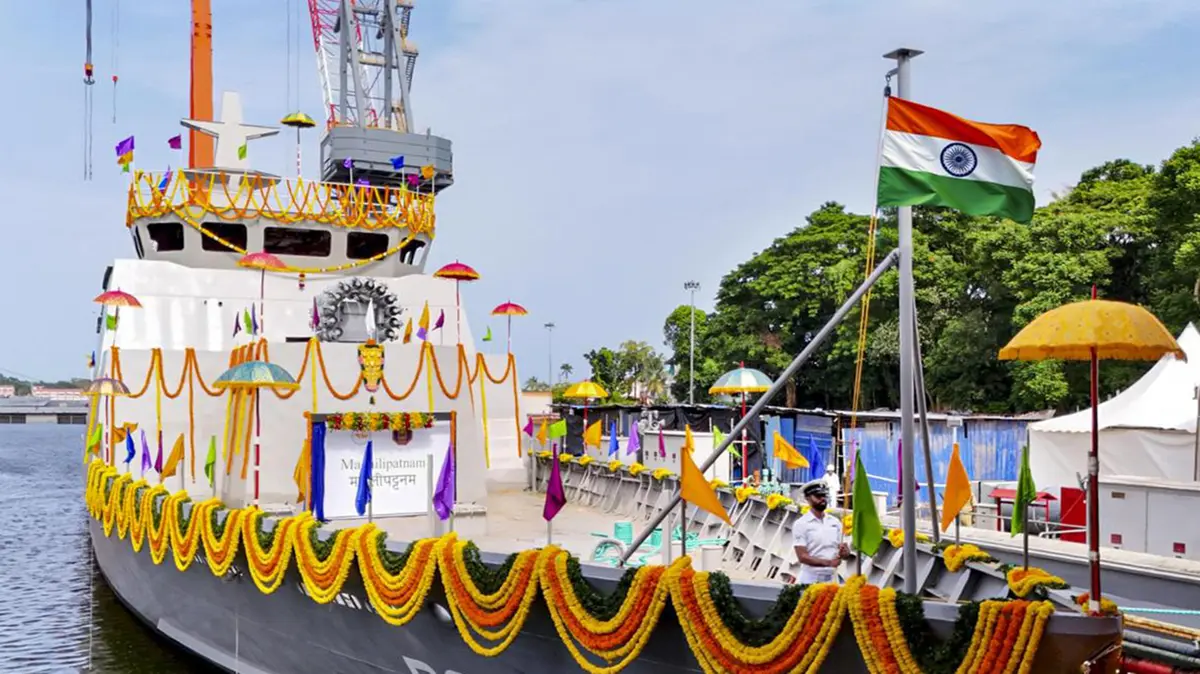
Why in news?
Cochin Shipyard launched Machilipatnam at Kochi on 29 July 2026. It is the seventh vessel within an eight-ship Mahe-class construction programme. The compact warship will support coastal anti-submarine operations after trials and commissioning. More than eighty per cent of its content is reported as indigenous.
Background
Machilipatnam is an Anti-Submarine Warfare Shallow Water Craft built for the Indian Navy.
This vessel category is commonly abbreviated as ASW-SWC after the full term appears.
The Navy contracted Cochin Shipyard during April 2019 for eight such vessels.
These Mahe-class ships will progressively replace older Abhay-class anti-submarine corvettes.
Machilipatnam carries the shipyard construction number BY 529 during its building phase.
Principal characteristics
| Feature | Reported specification |
|---|---|
| Displacement | Approximately 900 tonnes |
| Maximum speed | About 25 knots |
| Endurance | Approximately 1,800 nautical miles |
| Primary environment | Coastal and shallow-water operations |
| Indigenous content | More than 80 per cent |
A nautical mile equals 1.852 kilometres and remains the standard maritime distance unit.
A knot measures one nautical mile travelled during one hour.
What will the ship do?
Its principal task is detecting and countering submarines operating near India’s coast.
Shallow water creates difficult sonar conditions through noise, seabed reflections and temperature changes.
The craft therefore combines hull-mounted sonar with low-frequency variable-depth sonar.
Variable-depth equipment can search different water layers instead of remaining fixed near the hull.
The design also supports underwater surveillance, low-intensity maritime operations and mine-laying tasks.
Waterjet propulsion improves the vessel’s manoeuvrability within confined coastal operating areas.
Why are shallow-water capabilities important?
India has an extensive coastline, major ports, offshore infrastructure and busy sea approaches.
Conventional larger warships cannot always operate as efficiently inside confined coastal waters.
Smaller specialised vessels can patrol harbour approaches and respond rapidly to underwater contacts.
They complement maritime aircraft, helicopters, submarines and larger surface combatants.
Indigenisation and naming
The programme involves many Indian suppliers alongside the public-sector Cochin Shipyard.
Higher domestic content can strengthen supply chains, maintenance capacity and technological learning.
The vessel is named after Machilipatnam, a historic port city in Andhra Pradesh.
However, it should not receive the “Indian Naval Ship (INS)” prefix before formal commissioning.
The INS prefix normally follows a vessel’s formal entry into commissioned naval service.
Conclusion
Machilipatnam’s launch advances India’s specialised coastal anti-submarine fleet, but operational service will follow later.