

Why in news?
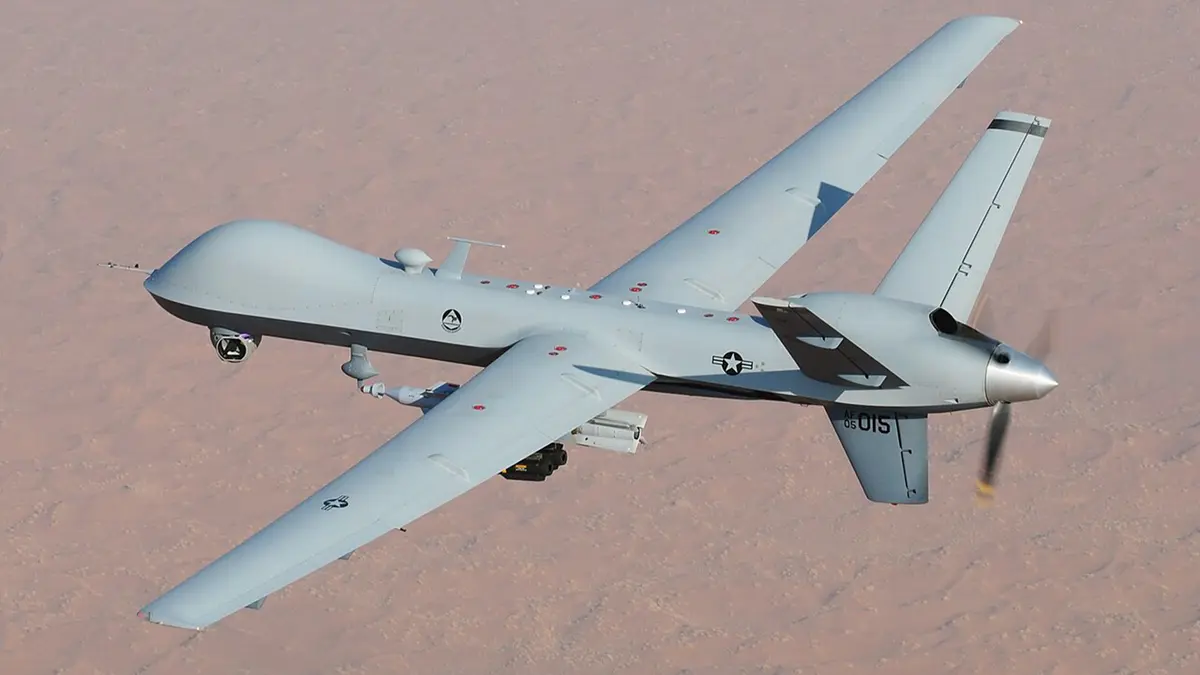
Iran’s Islamic Revolutionary Guard Corps claimed that it had shot down a United States MQ-9 Reaper near Qeshm Island. A 16 September Times of India report carried the account attributed to Iran’s Tasnim news agency. It explicitly noted that the claim lacked independent verification and immediate confirmation from the United States. The Reaper is a remotely piloted aircraft used for prolonged observation and, when equipped, strike missions. Qeshm’s position near the Strait of Hormuz gives the reported location wider strategic significance. The news is therefore an attributed claim of a loss, not an independently established destruction of a particular aircraft.
What the Reaper is designed to do
The MQ-9 Reaper is built by General Atomics Aeronautical Systems and developed from the company’s Predator family. It is a larger, more powerful aircraft than the earlier MQ-1. The United States Air Force records its initial operating capability in October 2007. Its primary role is collecting intelligence, with the ability to carry weapons for additional missions.
Intelligence, surveillance and reconnaissance are often grouped together as ISR. Surveillance involves watching an area or activity, while reconnaissance gathers information for a particular purpose. Intelligence emerges when collected information is assessed and interpreted. An aircraft’s cameras and other sensors supply observations; people and supporting systems still have to establish what those observations mean.
Remotely piloted does not mean uncrewed in every sense
There is no pilot seated inside the aircraft, but a crew operates it from the ground. The Air Force describes a basic remote crew of a pilot and a sensor operator. Ground-control equipment, communications links and maintenance personnel are also part of the system. The flying vehicle is therefore only one component of the overall capability.
This distinction is important when the word “drone” is used loosely. The Reaper is not simply launched to make every mission decision by itself. Remote control separates the crew’s location from the aircraft’s location. It does not remove the need for command arrangements, interpretation of information or responsibility for decisions about the use of force.
Why endurance and sensors matter together
The manufacturer describes the MQ-9A as a turboprop aircraft with endurance exceeding 27 hours in its stated configuration. A turboprop engine drives a propeller rather than relying solely on jet thrust. Long endurance allows repeated observation over time, which can reveal changes that a brief pass might miss. It does not mean every mission lasts the advertised maximum.
The manufacturer also lists operation up to 50,000 feet and several possible sensor packages. These include visible-light and infrared imaging, radar and equipment for maritime observation. Infrared sensing detects emitted thermal radiation, offering information different from an ordinary daylight image. Combining sensors can improve understanding, but the installed equipment varies with the aircraft and mission.
Specifications must therefore be tied to a variant and configuration. General Atomics separately describes an extended-range MQ-9A with additional fuel arrangements and longer endurance. The MQ-9B is another distinct development. Combining figures from these different versions would create a specification sheet for an aircraft that may not correspond to the one under discussion.
Where Qeshm fits on the map
Qeshm lies off Iran’s southern coast at the Strait of Hormuz. The strait sits between Iran and Oman and connects the Persian Gulf with the Gulf of Oman. Beyond that lies the Arabian Sea. The island is on the Iranian side of this passage. Its position links the country’s coastal geography with a heavily used regional shipping route.
Hormuz is important because it is a narrow passage used by shipping entering or leaving the Persian Gulf. The United States Energy Information Administration explains how disruption at such a chokepoint can delay supplies and increase transport costs. That geography helps explain attention to military incidents nearby. It does not independently establish the details of the reported drone incident.
What can and cannot be concluded from the claim
The report provides an identifiable source for the allegation: an Iranian military statement carried by a news agency. That is enough to report what was claimed, with clear attribution. It is not enough to establish the aircraft’s identity, circumstances of loss or cumulative losses claimed by one side. Those conclusions need additional evidence specific to the incident.
The aircraft’s published capabilities likewise cannot settle whether a particular interception occurred. A technical factsheet explains the system; it is not a combat-loss record. Conversely, the absence of immediate United States confirmation does not by itself prove the claim false. The responsible position is to retain the claim as news while keeping its verification status explicit.
Conclusion
The Reaper combines a long-endurance aircraft, remote crews and multiple sensors into a persistent observation and strike-capable system. Its role explains why a reported loss attracts attention, while Qeshm’s geography explains the regional interest. Neither point verifies the Iranian account. Until further evidence establishes the incident, the distinction between a reported claim and a confirmed loss must remain clear.