

Why in news?
A French air contingent reached Jodhpur on 25 September as part of Mission Pegase 26, its long-distance overseas deployment. The contingent includes four Rafale F4 fighters, three A330 tanker-transports and two A400M transport aircraft. It is due to participate in India's Tarang Shakti exercise from 28 September to 12 October. The visit demonstrates how combat aircraft depend on refuelling, transport and coordination to operate far from home. For India and France, the exercise also provides an opportunity to practise working together. As of 26 September, the aircraft's arrival was confirmed; the scheduled exercise and its operational outcomes still lay ahead.
A deployment, not simply a flight by fighters
Pegase 26 is the seventh edition of the French mission. The Ministry of the Armed Forces described a deployment running from 8 September to 15 October. Around 300 personnel support a journey of roughly 40,000 kilometres. Those figures describe the planned mission's scale, not the distance covered by every aircraft in a single flight. Stopovers and support arrangements make such a deployment possible.
The mission's purpose is to practise projecting air power over long distances while maintaining relationships with partners. France also has territories and responsibilities beyond continental Europe. Its official account connects the deployment with the ability to respond to events in distant regions. This is a statement of strategic purpose; a training journey does not, on its own, prove readiness for every possible emergency.
Three aircraft roles within one contingent
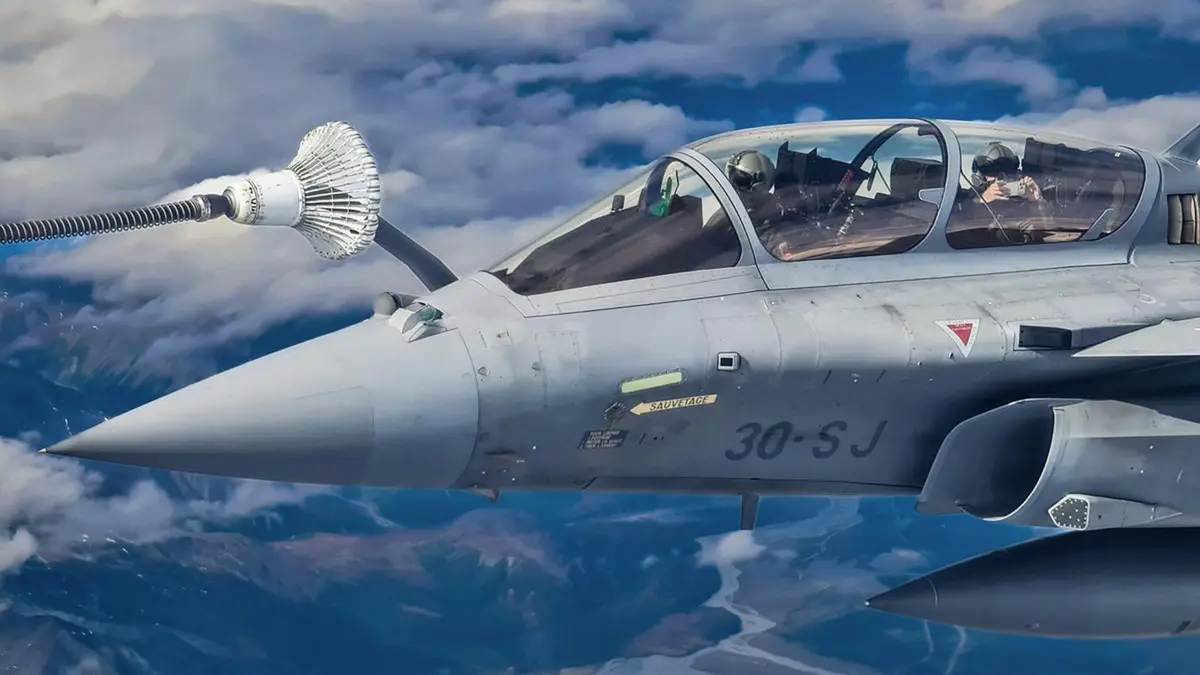
The Rafale F4 is the fighter element. Fighters can perform combat missions, but fuel, equipment and personnel must also reach their operating locations. This is where the support aircraft matter. The A330 Multi Role Tanker Transport, called Phénix in French service, combines aerial-refuelling and transport functions. It can transfer fuel in flight, extending the practical reach and endurance of compatible aircraft.
Aerial refuelling reduces dependence on landing solely to replenish fuel, but it introduces its own coordination requirements. Aircraft must meet at the planned place and time, follow safe procedures and manage fuel reserves. A tanker therefore supports the mission rather than making distance irrelevant. Its availability, routing and support arrangements become part of the operational plan.
The A400M Atlas supplies the transport element. Moving equipment and personnel allows a deployed force to function after its fighters arrive. Maintenance, communications and ground support cannot be assumed to appear automatically at a new base. Looking at the contingent as a whole explains why the number of fighters alone gives an incomplete picture of the operation.
Why the route matters
The French launch account described stages through Greenland, Canada and Alaska before the western Pacific and Asia. Japan, South Korea, Indonesia and India featured in the wider itinerary. These locations show the mission's progression across northern routes and into the Indo-Pacific. Jodhpur lies in Rajasthan, in north-western India, giving the visiting aircraft a land-based operating location for the forthcoming exercise.
The mission is therefore broader than the Indian stop. Its different stages test the ability to organise movement and support across changing environments and partner arrangements. Distance increases the importance of permissions, maintenance planning and coordination. The route also creates repeated opportunities for military contact. It should not be mistaken for a permanent French basing arrangement in every country visited.
Coordination continues from France
A French operations centre at Lyon-Mont Verdun supports the deployment from the home country. The defence ministry described a team coordinating planning, movements and adjustments while the aircraft operate abroad. This is an important part of the mission's design: the deployed contingent and the home-based command structure must remain connected. Aircraft mobility is only useful when decisions and support can keep pace.
Weather, available facilities and changing requirements can affect a long itinerary. A command structure must respond without losing sight of the whole mission. This explains why the French account emphasises planning and coordination alongside flying. Such work is less visible than the arrival of fighters, but it helps turn separate aircraft movements into an organised deployment.
What Tarang Shakti can add
The Indian exercise offers an opportunity to practise procedures with partner air forces. Working together requires more than owning advanced aircraft. Participants need compatible ways to communicate, plan missions and operate safely in shared airspace. Training can expose differences and build familiarity before cooperation is required under pressure. These are practical aims, not evidence that every participating force has identical equipment or doctrine.
The timing also matters. Arrival on 25 September allows the contingent to prepare before the announced exercise period. It does not establish that the exercise had already begun, nor that its goals had already been achieved. Assessing results requires information from the actual training, rather than treating the deployment announcement as its completion report.
Conclusion
Mission Pegase 26 illustrates the support system behind long-range air operations. Fighters, tankers, transports and command arrangements perform different but connected jobs. The Jodhpur stop brings that system into cooperation with India through the upcoming Tarang Shakti exercise. Its significance lies in practising sustained deployment and shared procedures; the results must be judged from what the participants actually do.