

Why in news?
The Supreme Court addressed Tamil Nadu fishers’ access to offshore fishing grounds on 2 September 2026. Their vessels carry purse seine nets through waters regulated by the State. The Court directed timely processing of access applications and the designation of transit channels. Its decision links lawful offshore fishing with coastal conservation and cooperation between governments.
How purse seine fishing works
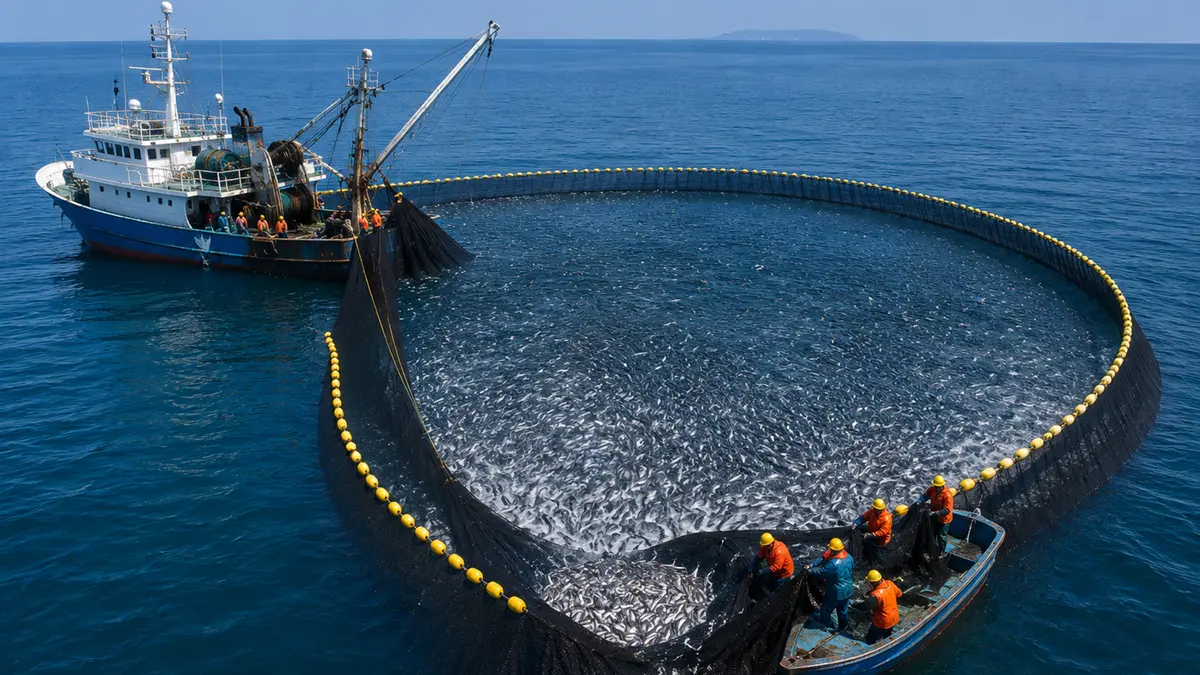
A purse seine is a large net placed around a shoal. Floats support its upper edge, while the lower edge can be drawn together. Closing that lower opening prevents fish from escaping downwards. The method is designed to surround fish, unlike a bottom trawl dragged along the seabed.
This method can catch large quantities of schooling fish efficiently. Its environmental effects depend on the species, location and fishing practices involved. Unwanted animals may become trapped alongside the intended catch. Therefore, management must examine actual catches and fishing conditions, rather than treating every operation as identical.
Efficiency also creates a question about the total pressure on fish stocks. A productive net does not make unlimited fishing sustainable. Managers need information about fishing effort, juvenile catches and stock recovery. The interests of smaller fishing vessels must also enter decisions about coastal access.
Why the maritime boundary matters
The dispute concerns the boundary between two regulatory areas. India’s territorial sea extends up to twelve nautical miles from the legally defined baseline. Beyond it lies the exclusive economic zone, or EEZ. This zone can extend to 200 nautical miles from the baseline, subject to applicable maritime boundaries.
The EEZ gives India specific sovereign rights over marine resources. It is not identical to sovereign land territory or the territorial sea. Within India’s constitutional framework, States regulate fisheries in territorial waters. Parliament has authority over fishing and fisheries beyond territorial waters under Union List Entry 57.
For a fishing vessel, these legal zones form one continuous journey. It must leave a coastal harbour before reaching offshore fishing grounds. Tamil Nadu’s coastal rules therefore affect access to centrally regulated waters. A workable system must distinguish transit with fishing gear from using that gear within a prohibited area.
The rules behind the dispute
Tamil Nadu prohibited purse seine fishing in its territorial waters through an order dated 25 March 2000. The order used powers under the Tamil Nadu Marine Fishing Regulation Act, 1983. Rule 17(7) of the State’s 2020 rules also restricts this fishing method. The State cited conservation and enforcement concerns when defending its approach.
The Union notified the Sustainable Harnessing of Fisheries in the Exclusive Economic Zone Rules, 2025, on 4 November 2025. These rules created a framework for access passes and fisheries management. Central authorities issue the passes, while designated State officers verify applications and vessels. The framework also provides for conservation, monitoring and reporting responsibilities.
The Supreme Court found no conflict between the two regulatory systems. Each government exercises authority within its own constitutional field. However, the systems must work together when vessels cross between those fields. Coastal regulation cannot become an indefinite administrative barrier to lawful offshore activity.
What the judgment changes
The Court recorded substantial delays in Tamil Nadu’s verification of applications. It directed effective and timely clearance under the applicable rules. It also required the State to designate channels for vessels carrying purse seine nets offshore. Rules 15(5) and 15(6) of the State’s 2020 framework provide the basis for these channels.
This is not a general withdrawal of Tamil Nadu’s coastal restrictions. Nor does it create unrestricted fishing rights throughout the EEZ. Fishers remain subject to the relevant laws and access conditions. The ruling instead requires an administratively workable connection between the State and Union systems.
The practical test will be whether permissions and monitoring support each other. Clearly marked routes can help separate transit from fishing activity. Reliable catch records can support decisions about conservation measures. Transparent processing can also reduce uncertainty for fishers who must plan trips, labour and operating expenses.
Conclusion
The judgment treats federal cooperation as a practical requirement for fisheries management. Fishers need usable access to lawful fishing grounds. Coastal communities also need enforceable safeguards for resources and livelihoods. Timely permissions, designated channels and scientific monitoring should advance both objectives. The outcome will depend on consistent implementation, not simply the existence of separate rules.