

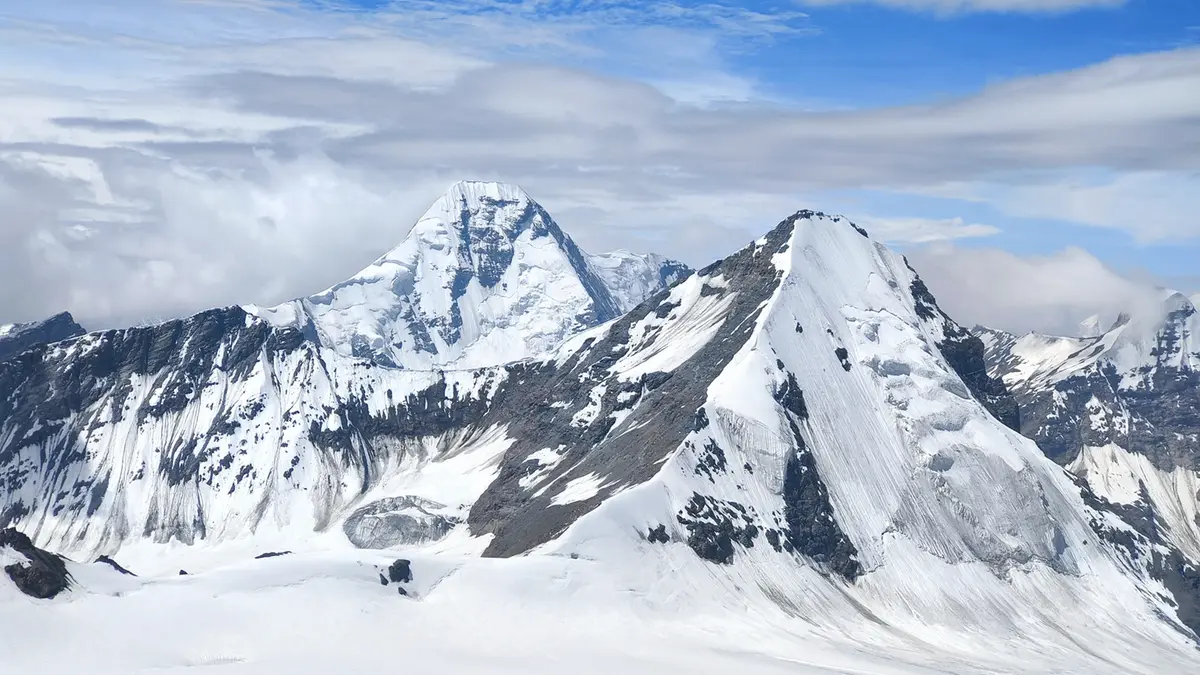
Why in news?
A four-member team from Munnar reached Ramjak’s summit on 10 September 2026, according to its account in The Hindu. The newspaper reported the achievement on 15 September. Ramjak is a 6,318-metre mountain in Lahaul, in Himachal Pradesh, near the route towards Shingo La and Zanskar. The climbers described a demanding expedition involving altitude preparation, fixed ropes and high camps. Its significance is not that the mountain was previously unclimbed: an earlier expedition made the recorded first ascent in 2002. The recent climb instead draws attention to a less familiar Himalayan peak whose snow, ice and rock present serious technical obstacles. Its climbing history shows why elevation alone cannot measure a mountain’s difficulty.
Placing the mountain on the map
Lahaul forms part of Himachal Pradesh’s Lahaul and Spiti district. Ramjak lies south of Shingo La, on the Himalayan approach between Darcha and the Zanskar region of Ladakh. Mountaineering accounts place the approach around Chikka, Palamo, Jankar Sumdo and Chuminakpo. These names describe stages along the approach, not alternative names for the summit.
Shingo La is a mountain pass connecting the Lahaul side with Zanskar. A pass is a crossing through a range, while Ramjak is an elevated summit requiring a separate ascent. Being close to a recognised trekking route therefore does not make its summit a routine extension of that trek. Route-finding becomes a different problem once climbers leave the valley approach.
What the recent team reported
The Hindu identified the climbers as Kannan M., Vinod Jacob, Prince Jacob and Shijo Jose. They said the expedition took ten days, with a summit arrival around 8.30 a.m. on 10 September. Their reported base camp was at 4,700 metres and summit camp at 5,800 metres. These are details of this party’s expedition rather than permanent camp locations for every future climb.
The team also described repeated acclimatisation hikes before its final ascent. Acclimatisation is the body’s adjustment to reduced oxygen availability at altitude. It is distinct from technical climbing ability: experience with ropes does not eliminate the physiological demands of a high mountain. Their preparation account helps explain why an expedition involves much more than the final hours towards the top.
The earlier attempts explain the challenge
A first-hand Himalayan Journal account of the 2001 attempt describes loose rock, hanging ice and a long ridge still separating climbers from the summit. The party reached roughly 5,800 metres but withdrew because the remaining terrain was too difficult. Its experience illustrates the difference between gaining altitude and finding a practicable continuation of the route.
The Indian Mountaineering Foundation’s successful 2002 expedition was led by Sangay Dorjee Sherpa. The American Alpine Journal records that Sherpa reached the summit on 4 August with Mul Dorjay, Nima Dorjay and Dawa Wanchuk. That account appeared in the 2003 journal. The publication year must therefore not be mistaken for the year of the ascent itself.
A later Himalayan Journal account records another attempt in 2021. It describes access to a base-camp area beside a motor road, followed by much more demanding climbing above. Better approach access can reduce transport difficulties without removing the hazards of the mountain. Road development and summit accessibility are related, but they are not interchangeable.
Understanding the snow-and-ice vocabulary
The expedition reports describe crevasses, seracs and cornices. A crevasse is a crack in glacier ice. A serac is a large block or tower of ice, which may become unstable. A cornice is an overhanging accumulation of wind-deposited snow along a ridge. Each presents a different obstacle; none is simply another word for snowfall.
These features also explain why a route cannot be judged from a smooth-looking distant photograph. Snow may hide a crack, while an apparently solid ridge edge may overhang empty space. Historical accounts document such terrain on Ramjak, but they do not establish the exact condition of every slope on the recent expedition’s date.
Fixed ropes assist movement across selected difficult sections. They do not transform unstable terrain into a permanently safe path. A route depends on the condition of snow and ice, weather and the remaining descent as well as the climb. The 2001 withdrawal is therefore part of the mountain’s instructive history, not merely a failed entry before a later success.
Conclusion
Ramjak’s recent ascent is best understood through both geography and the earlier expedition record. The mountain lies near an important Himalayan crossing, yet its summit demands much more than reaching that route. The Munnar team’s account adds a new chapter to an established climbing history whose central lesson is that terrain matters as much as height.