

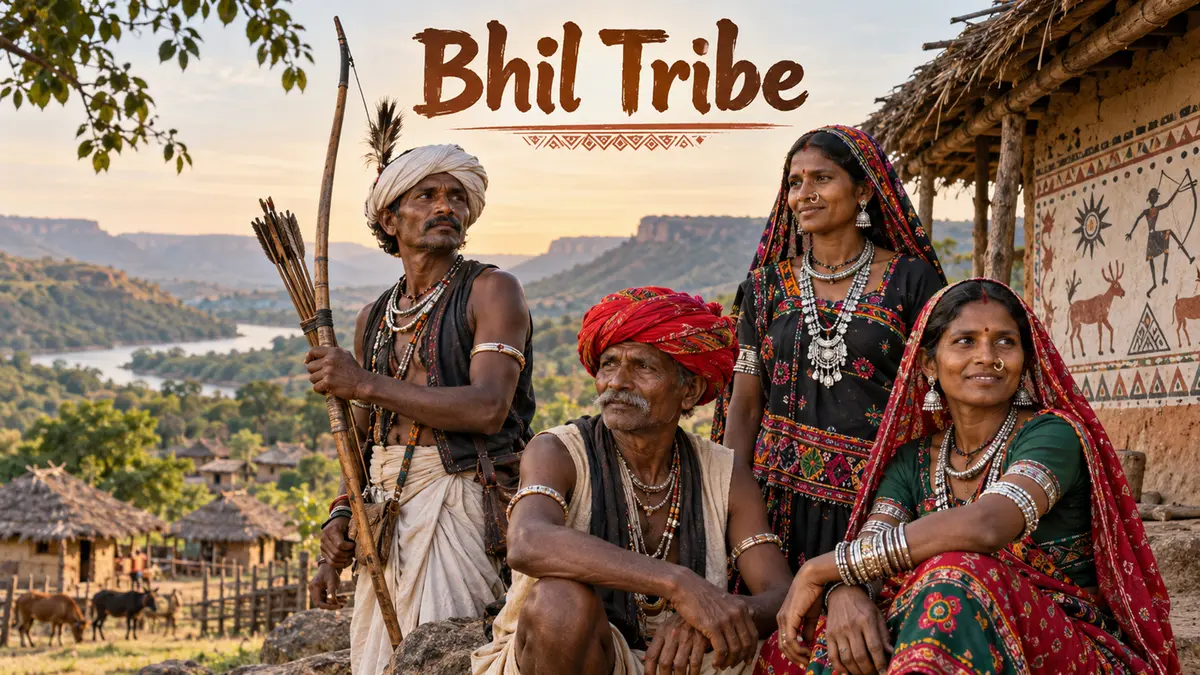
Why in news?
The Rajasthan High Court has sought responses to a petition seeking a separate share for the Bhil community within the state's Scheduled Tribe reservation. A legal report dated 18 September describes a demand for a 9 per cent sub-quota within the existing 12 per cent quota. The petition raises questions about how reservation benefits are distributed among eligible tribal communities. The reported procedural step is the issuing of notices, not an order granting the requested arrangement. Its importance lies in the wider debate over unequal access within a protected category. The petitioners' claims about representation and disadvantage still require examination; they should not be presented as findings already accepted by the court.
A large and diverse community across western and central India
Bhil communities are spread across several states, particularly Rajasthan, Gujarat, Madhya Pradesh and Maharashtra. Their distribution crosses modern state boundaries and includes varied local histories and social practices. The name therefore should not suggest one uniform settlement pattern, occupation or cultural tradition. It also does not identify a single isolated population living outside contemporary economic and social change.
The Ministry of Tribal Affairs' statistical profile groups Bhils and a number of related notified names in its 2011 Census tables. These include names such as Bhilala, Barela, Pawra and Vasava within the relevant aggregate. Such a table is useful for understanding demographic scale, but its total depends on the grouping used. It should not be turned into a claim that one narrowly defined subgroup has the same population everywhere.
Livelihoods, art and local identity
Accounts documented by the Indira Gandhi National Centre for the Arts describe agriculture, labour and close relationships with local landscapes. Practices vary between regions and households. Changes in employment, migration and access to education form part of contemporary community life. A description limited to bows, forests or a supposedly unchanging ancient lifestyle would obscure that diversity rather than explain it.
The centre also documents Pithora painting in parts of the Bhil cultural region, including the Jhabua area of Madhya Pradesh. These paintings can form part of ritual practice, oral tradition and relationships with deities and ancestors. They are not simply decorative patterns detached from community life. At the same time, a tradition documented in one area should not be attributed identically to every Bhil household across four states.
What the petition asks the court to examine
According to The Law Advice, the petition argues that the Bhil community has not received an equitable share of reservation benefits. It alleges disproportionate benefit to another community within the Scheduled Tribe category and seeks a separate allocation. These are the petitioners' arguments. The report does not establish that the High Court has accepted the supporting demographic or employment claims as proved.
A sub-quota divides benefits within an existing reserved category rather than necessarily enlarging the overall reservation. That is why the reported demand must be described as being within the existing 12 per cent quota. A request for interim relief is also different from relief actually granted. The available report describes notices seeking responses; it does not justify announcing a new operative reservation rule or a general suspension of appointments.
Recognition and distribution are different constitutional questions
Article 342 of the Constitution governs the identification of Scheduled Tribes for particular states or Union territories. The President specifies the relevant list, and Parliament can amend it by law. This recognition question is distinct from how benefits are distributed among communities already included. A state-level demand for a different allocation does not automatically add a community to, or remove one from, the constitutional list.
The debate also draws attention to the Supreme Court's 2024 judgment in State of Punjab v. Davinder Singh. The majority permitted sub-classification within Scheduled Castes under constitutional conditions. It rejected the assumption that inclusion in one notified category makes every group identically situated for every purpose. The judgment nevertheless required a rational basis linked to the objective of the measure, rather than an arbitrary political division.
The Court emphasised evidence about disadvantage and inadequate representation. Its ruling did not itself create a Bhil quota in Rajasthan. The case before it concerned Scheduled Castes, while the present petition concerns Scheduled Tribes. How the constitutional principles apply to the particular demand must be assessed in the relevant proceedings. A precedent provides a legal framework; it is not a substitute for the facts and orders of a later case.
Why the evidence needs careful definition
Assessing unequal access requires clarity about what is being measured. Population share, applications, selections and representation in public services are different quantities. A comparison may change depending on the time period, department, educational qualifications or geographical area examined. A broad assertion that a community receives too much or too little cannot replace that work. Reliable data and fair treatment of affected groups are central to evaluating the demand.
Conclusion
The Rajasthan petition raises a serious question about access to reservation benefits within a diverse constitutional category. The Bhil community's wide distribution and regional variation make careful evidence especially important. For now, the confirmed news is a reported request for responses in an ongoing case, not approval of a new quota. Further orders and examined data will determine whether the demand produces a legally sustainable change.