

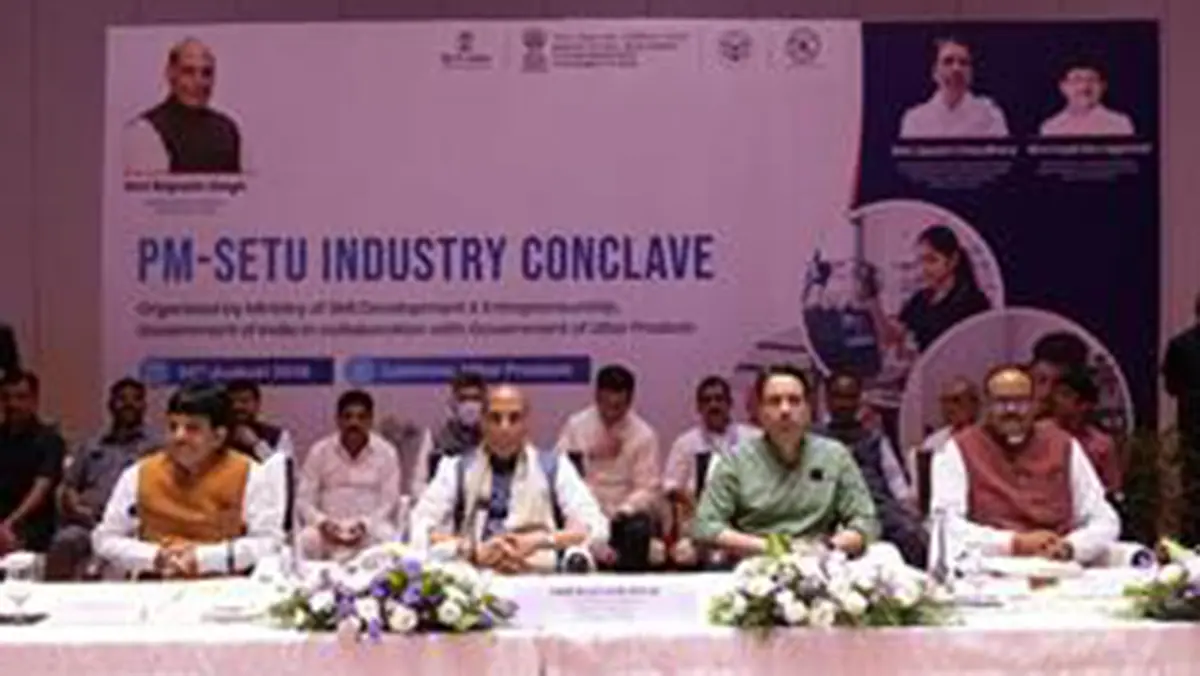
Why in news?
The Skill Development Ministry and Uttar Pradesh held a training conclave in Lucknow. It focused on Pradhan Mantri Skilling and Employability Transformation through Upgraded ITIs, called PM-SETU. Industrial Training Institutes, or ITIs, were central to the discussions. The event sought industry partners for institute clusters across the state.
What PM-SETU is
PM-SETU is a Centrally Sponsored Scheme for upgrading vocational institutions. The Union Cabinet approved the national programme in May 2025. Industry partners are expected to guide clusters of training institutes. Government financing supports the wider reform.
The Prime Minister launched PM-SETU in October 2025. The launch followed the Cabinet approval and scheme design. Implementation now depends on state proposals and industry partners. Clusters move forward after their detailed plans receive approval.
The scheme has a five-year outlay of ₹60,000 crore. The Union share is ₹30,000 crore. States contribute ₹20,000 crore and industry contributes ₹10,000 crore. Development banks co-finance part of the Union share.
The programme aims to upgrade 1,000 government Industrial Training Institutes. Two hundred institutes will become hubs. Eight hundred institutes will operate as spokes. It also targets twenty lakh learners over five years.
How the hub-and-spoke model works
One hub generally connects with four spoke institutes. The cluster can share advanced laboratories and specialist trainers. Spokes extend access to nearby learners. Courses should reflect the industrial potential of the region.
Each cluster may receive investment up to ₹241 crore. The reported pattern assigns fifty per cent to the Union government. States contribute thirty-three per cent. Industry partners provide the remaining seventeen per cent.
Special Purpose Vehicles are proposed for cluster management. Anchor industry partners hold 51 per cent ownership. The Union and state governments hold 24.5 per cent each. This structure gives industry a formal leadership role.
The Lucknow conclave
Participants included defence public enterprises and sector skill councils. They discussed aerospace, shipbuilding and electronics manufacturing. Precision engineering, advanced welding and mechatronics also featured. Drone technologies created another training demand.
Uttar Pradesh had identified thirty-two institutes in eight clusters. Seven remained open for industry collaboration at the meeting. Approved partnership proposals nationally represented more than ₹1,500 crore. They covered seven clusters across five states.
The National Skill Development Corporation also signed a memorandum with Lucknow Cantonment Board. Their proposed Shaurya Academy will prepare youth for uniformed services. This separate initiative accompanied the conclave. It should not be confused with every PM-SETU cluster.
The second component
PM-SETU also strengthens five National Skill Training Institutes. They are in Bhubaneswar, Chennai, Hyderabad, Kanpur and Ludhiana. Each can host a sector-specific National Centre of Excellence. The focus includes advanced training for trainers.
International partnerships can bring new equipment and teaching methods. They should be adapted to Indian industry and learner needs. Trainer quality decides whether modern machines improve education. Continuous professional development is therefore essential.
National institutes can also create common resources for many training centres. Digital content and updated occupational standards can spread more widely. Assessment must test practical competence. Certificates alone do not prove workplace readiness.
Why reforming ITIs matters
Industrial Training Institutes provide trade-based vocational education after school. Many serve learners seeking faster entry into employment. Employers often report gaps between certificates and job requirements. Equipment and curricula can lag behind workplace technology.
Industry participation can improve course design and apprenticeships. It can also provide instructors with current shop-floor experience. Production units and incubation centres may expose learners to real work. Placement services can connect training with outcomes.
However, employers may focus on immediate vacancies. Public institutions must also teach transferable foundations. Safety, mathematics, digital literacy and communication remain important. Learners need skills that survive one company’s technology cycle.
Governance and inclusion challenges
Industry-led management needs clear public accountability. Special Purpose Vehicles should publish contracts, spending and results. Conflicts of interest must be disclosed. Government ownership does not remove the need for independent audit.
Outcome measures should include completion, apprenticeships and sustained employment. Starting wages and job quality also matter. Placement numbers can be misleading when jobs are very short. Comparable public data will reveal which clusters work.
Women remain under-represented in many industrial trades. Safe hostels, transport and sanitation can improve access. Training should challenge occupational stereotypes. Persons with disabilities need suitable equipment and reasonable accommodation.
Rural and low-income learners may face relocation costs. Spoke institutes can reduce distance, but advanced facilities may remain at hubs. Travel support and scheduling can keep access fair. Digital materials should supplement, not replace, hands-on training.
Financing and long-term sustainability
Modern machines require maintenance, consumables and trained instructors. Capital grants can create impressive laboratories that later remain unused. Cluster plans should budget the full equipment life cycle. Industry partners need enforceable responsibilities beyond launch events.
Courses should be revised when local demand changes. Labour-market evidence can guide those decisions. Students also need career counselling before choosing a trade. Honest information reduces mismatch and dropout.
The World Bank approved an 830 million dollar loan for the programme during 2026. The Asian Development Bank also supports reform. External financing brings targets and monitoring requirements. Public institutions must retain ownership of long-term capacity.
Upgraded buildings do not guarantee employability
Results depend on trainers, practical learning, employer engagement and job quality. These outcomes require measurement long after construction finishes.
Conclusion
The Lucknow conclave connected PM-SETU with real industrial skill demands. Its cluster model can share costly facilities across several institutes. Industry leadership may keep training closer to changing workplaces. Strong safeguards must protect inclusion and public accountability. Success should be judged through durable skills and decent employment.