

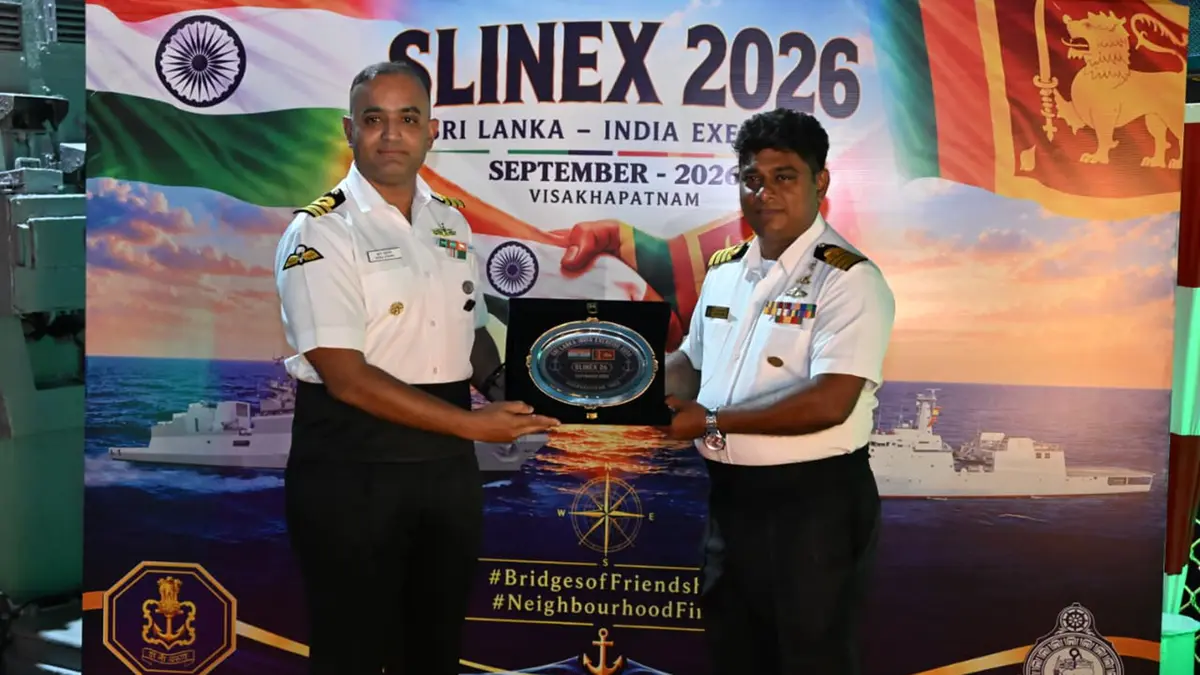
Why in news?
India and Sri Lanka are holding the thirteenth Sri Lanka–India naval exercise (SLINEX) at Visakhapatnam. The programme runs from 17–21 September 2026, according to India's Ministry of Defence announcement on 20 September. It brings the two navies together first in harbour and then at sea, where they practise coordinated operation. Indian Naval Ships Kavaratti and Jyoti are participating alongside Sri Lanka Naval Ship Sindurala. The practical aim is to help crews communicate and work together despite operating different ships and following national procedures. The exercise is a training and cooperation activity, not a new defence treaty or a change to the countries' maritime boundary.
Where the exercise fits on the map
Visakhapatnam lies on Andhra Pradesh's coast, facing the Bay of Bengal. It is therefore on India's eastern seaboard, not on the Arabian Sea. Sri Lanka is an island country southeast of the Indian peninsula and has no land border with India. The Palk Strait and Gulf of Mannar lie between Sri Lanka and Tamil Nadu. These waters are distinct from the exercise area farther north off Visakhapatnam.
The geography gives the two countries continuing reasons to communicate at sea. Ships, fishing vessels and weather systems do not remain within the boundaries of a training area. A crew may need to understand another navy's messages before an unfamiliar situation becomes urgent. This is the practical setting for maritime cooperation. It does not mean that every bilateral exercise addresses every outstanding fisheries or boundary-related issue between the countries.
What SLINEX is intended to build
The name SLINEX refers to the Sri Lanka–India naval exercise. India's official account traces its conception to 2005 and identifies the 2026 programme as its thirteenth edition. Those facts should not be read as proof of an uninterrupted annual sequence since 2005. The emphasis is on professional exchange, mutual understanding and interoperability. In plain language, interoperability means being able to perform a task together without incompatible procedures preventing cooperation.
Consider a coordinated movement by two ships. Each crew needs to understand the intended course, timing, communication method and safety arrangements. Merely possessing capable equipment does not guarantee that shared understanding. Rehearsal lets participants identify a confusing instruction or different expectation before it matters in a real operation. Interoperability therefore involves people and procedures as well as hardware, with the practical aim of reducing avoidable friction during a shared task.
Why training begins alongside the jetty
The harbour phase allows crews to meet, visit one another's ships and discuss working methods. The official programme includes professional exchanges, cross-deck visits and the sharing of practices, alongside cultural and sporting interaction. Familiarity with another ship's layout and team can make later coordination easier. The Sri Lanka Navy reported Sindurala's arrival on 17 September. Its commanding officer held discussions with Kavaratti's commanding officer the following day.
The sea phase then moves the relationship into an operating environment. Sri Lanka's 19 September account scheduled that phase for 20 and 21 September off India's east coast. India's announcement described coordinated activities at sea without publishing a detailed list of every drill. This sequence connects discussion ashore with the demands of operating ships together. Conditions at sea make clear communication and agreed procedures more consequential than they are during an exchange alongside a jetty.
Three ships, different functions
Kavaratti is an anti-submarine warfare corvette, a warship designed with a particular emphasis on threats beneath the surface. Commissioned in October 2020, it belongs to India's Project 28 programme. Its official commissioning account describes underwater sensors and anti-submarine weapons. Detection and response are connected but separate tasks: the first establishes what may be present, while the second concerns what to do about it. A specialised ship contributes that operational perspective to joint training.
Jyoti is a fleet tanker, bringing the support role into the exercise alongside a combatant. Fuel and supplies help determine how long ships can remain at sea, so maritime capability is not limited to weapons. Sindurala is a Sri Lankan advanced offshore patrol vessel built by Goa Shipyard in India. The Sri Lanka Navy's records identify its patrol role and Indian construction. These different functions illustrate why coordination involves more than matching ships of identical design.
Cooperation without confusing its legal effect
Training together can improve working relationships, but it does not transfer command of one country's navy to the other. Nor does an exercise redraw maritime limits. India and Sri Lanka's maritime arrangements rest on separate agreements and diplomatic processes. Maintaining that distinction helps explain both the value and limits of SLINEX. It develops practical cooperation while the countries retain their own responsibilities and decision-making authority.
Conclusion
SLINEX links harbour-level familiarity with coordinated activity in the Bay of Bengal. Its value lies in whether crews understand one another and can work safely together when circumstances require it. The participating ships bring different roles, making communication and common procedures especially important. This practical relationship can develop without an alliance commitment. Its strongest result would be crews better prepared to cooperate when a real maritime situation requires it.